|
July 2026 – Volume Thirty-Two, Number Seven
Celebrating our 32th year!
EXPEDITION NEWS, founded in 1994, is the monthly review of significant expeditions, research projects, and newsworthy adventures. It is distributed online to media representatives, corporate sponsors, educators, research librarians, explorers, environmentalists, and outdoor enthusiasts. This forum on exploration covers projects that stimulate, motivate, and educate.
| | |
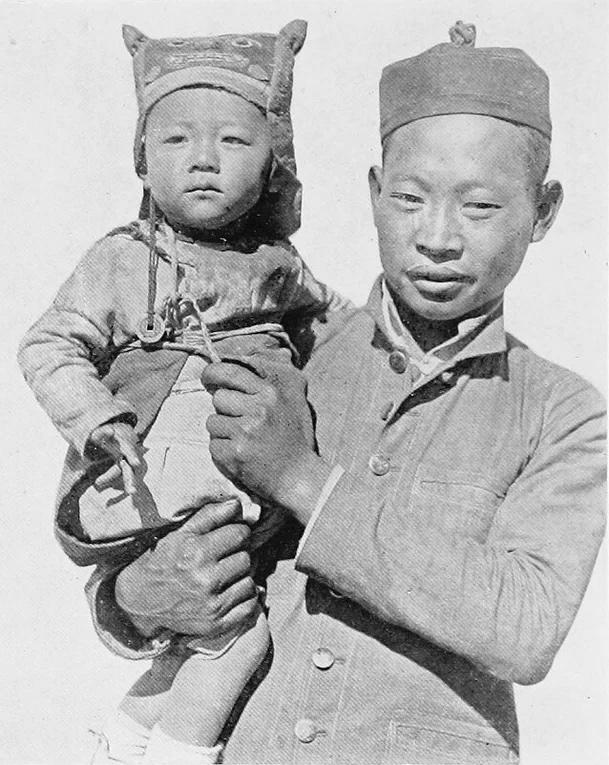
“Young China,” by Yvette Borup Andrews,
featured in Camps and Trails in China (1918).
(Photo: PublicDomainReview.org)
| | |
ROY CHAPMAN ANDREWS’ WIFE EMERGES FROM SHADOWS
While paleontologist Roy Chapman Andrews, one of the inspirations for the fictitious Indiana Jones character (see EN, May 2023), is famously celebrated for his Central Asiatic Expeditions and finding the first fossilized dinosaur eggs in the Gobi Desert, his often-overlooked first wife Yvette Borup Andrews (1891-1959) was an extraordinary explorer, filmmaker, and ethnographic photographer in her own right.
A visionary photographer, she captured images that preserved the essence of Mongolia’s people and culture a century ago.
Photos captured on their first expeditions through Central Asia, using an innovative rubber darkroom she developed for field work, stand today as a compelling contribution to early visual anthropology.
Nomadify, based in Mongolia, is organizing The Forgotten Legacy of Yvette Expedition later this month to honor her work and shine a light on the vital role women have always played in exploration.
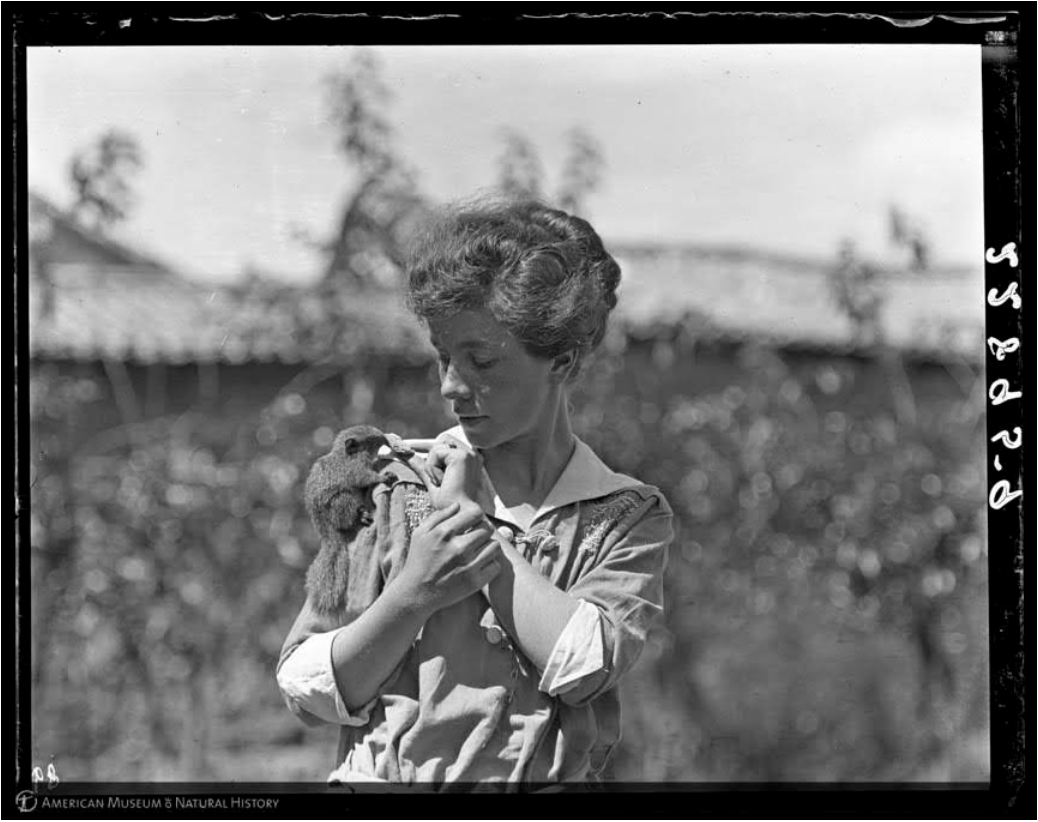
| | Yvette Borup Andrews (Photo: American Museum of Natural History) | | |
Andrews served as the official photographer on the American Museum of Natural History’s First and Second Asiatic Expeditions (1916-1917, 1918); and captured stunning, historic visual records of the people, wildlife, and landscapes across the frontiers of Tibet, Yunnan, China, and the Mongolian plains.
Despite her contributions to science and exploration, her legacy has frequently been overshadowed by her husband's fame.
Using Andrew’s photos, the approximately 10-person Nomadify team this month will trace her journeys, rediscover the places and culture she documented, and create a comparative study of 100 years. The trip begins in Ulaanbaatar, the capital of Mongolia, at a photo exhibition of her work.
“An explorer in her own right, Yvette seems to have been full of curiosity about the natural and cultural worlds she explored, dedicated to capturing images to reflect what she observed and learned, and full of joie de vivre, even in tough situations,” says expedition member Beth Davidow of Montrose, Colorado, a Fellow of The Explorers Club and member of the Society of Woman Geographers, who was granted an Explorers Club flag to take along.
"I'm excited to be joining the expedition to follow in her footsteps and learn more about the landscapes and people of Mongolia that Yvette found fascinating. Exploring the changes in the century since she was there will be a most interesting and fulfilling project."
For more information:
www.nomadify.mn
Learn more about Yvette Borup Andrews here:
https://untoldstories.net/1911/02/1916-first-asiatic-zoological-expedition-of-the-american-museum-of-natural-history/
QUOTE OF THE MONTH
“Only if we understand, can we care. Only if we care, we will help. Only if we help, we shall be saved.”
– Dame Valerie Jane Morris Goodall, Ph.D. (1934-2025), English primatologist and anthropologist. (This month’s quote honors the two-dozen South African rangers, veterinarians, pilots, volunteers and donors who came together last month to save two African white rhinos. See related story.)
EXPEDITION FOCUS
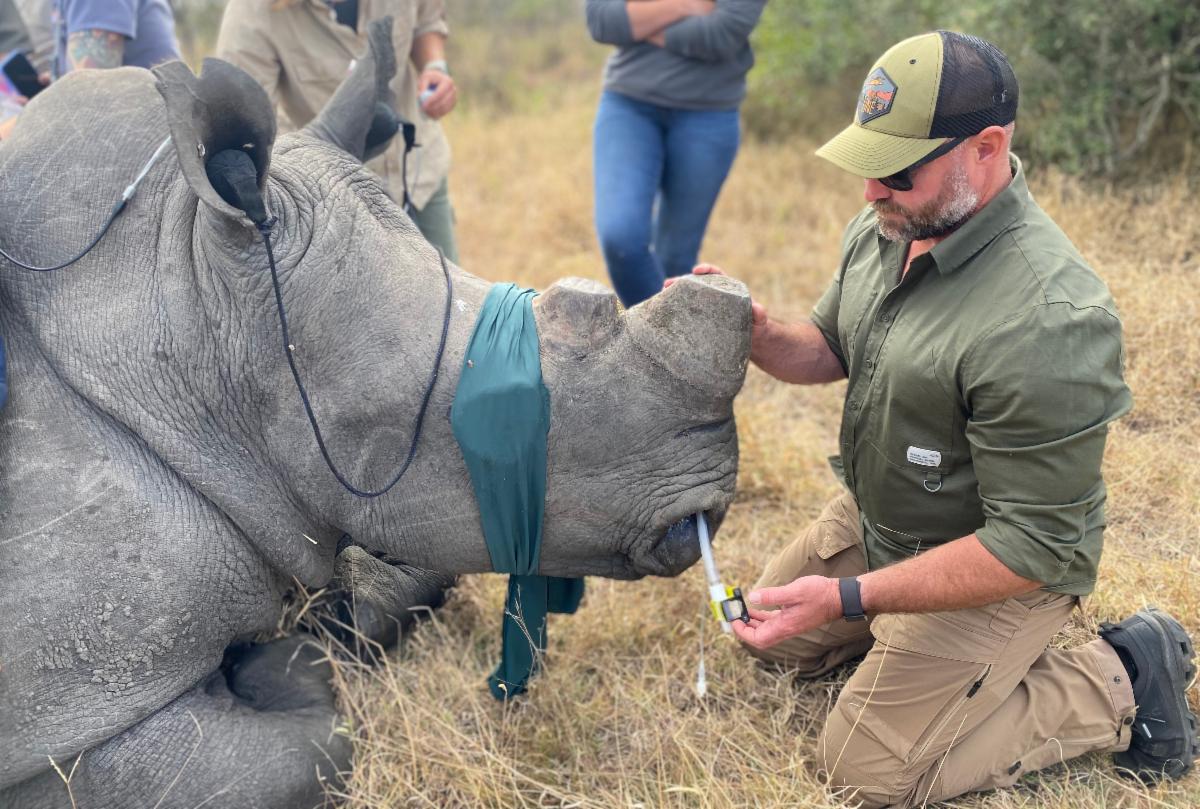
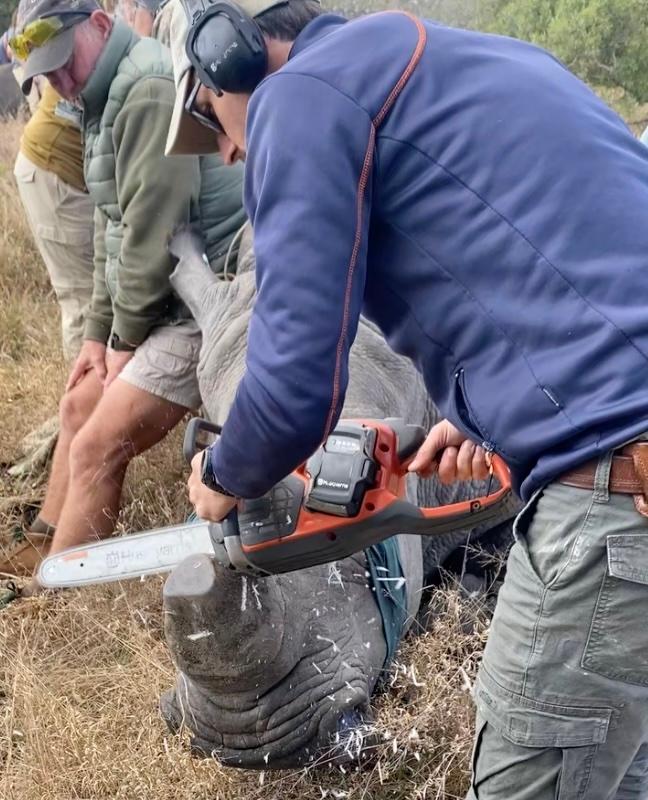
| | African white rhino is prepped for dehorning in South Africa last month. | | |
South African Rangers Dehorn Rhinos to Save Their Lives
At the Timbavati Private Nature Reserve bordering Kruger National Park in South Africa, a single engine aircraft circles overhead, looking for endangered African white rhinoceros hidden in the bush.
Down below a ruby red Raven II helicopter patiently waits with a veterinarian and a Pelican case full of immobilization tranquilizer – enough to temporarily take down a two-ton animal whose horn is worth an arm and a leg.
Rhino horn is valued more than gold or drugs on the Asian black market where it’s sought for its medicinal - and supposed aphrodisiacal - benefits.
Poachers will pay local villagers $3,000 per kg. (4.4 pounds) (or more) to bring then rhino horn – a fortune for those struggling in rural South Africa to feed a family.
| | |
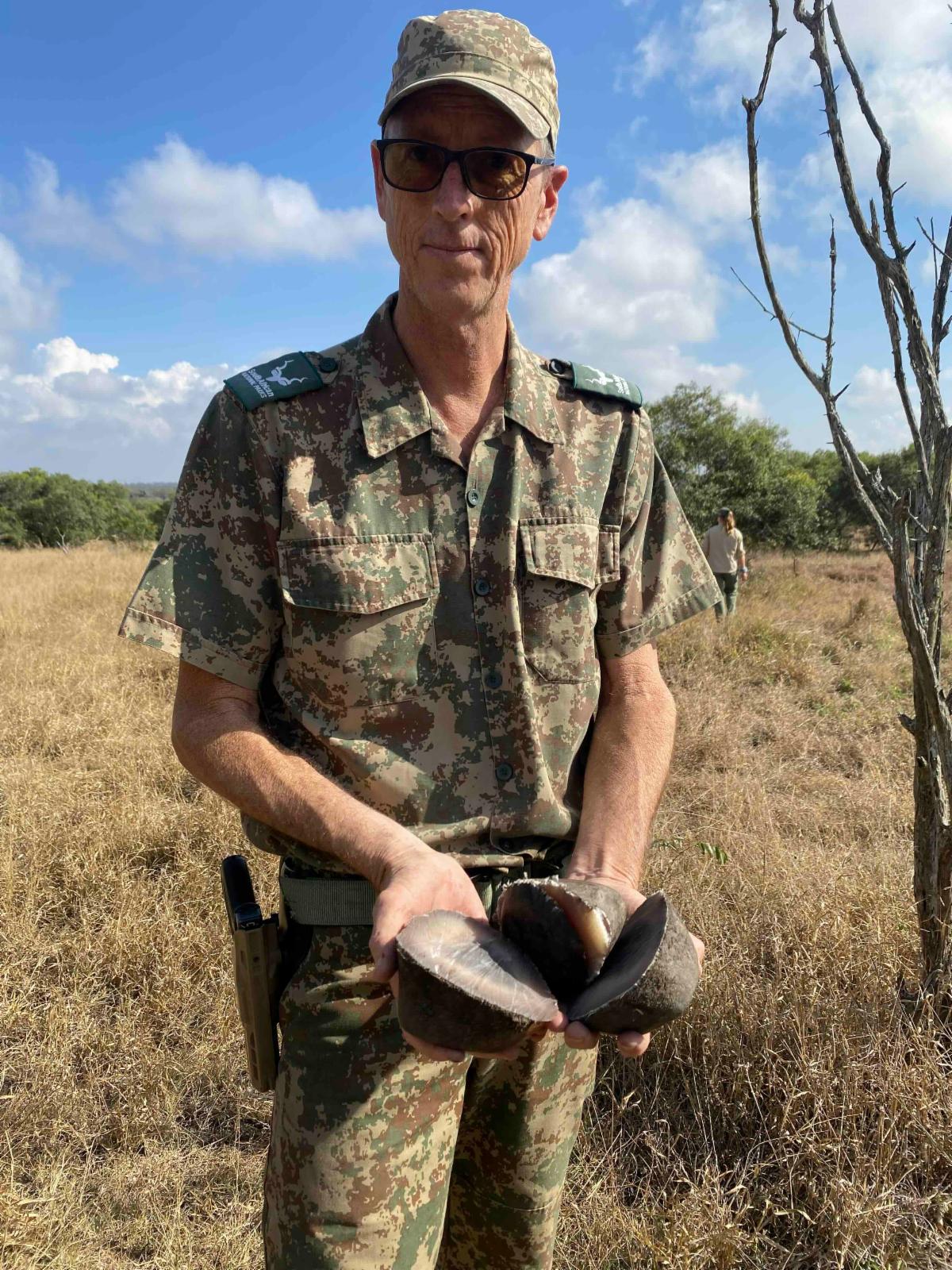
Ranger Greg Bond with about $110,000 worth of
recently trimmed horn (based on black market value).
| | |
By the time that horn, composed of keratin, like human fingernail, and hair, works its way through the black market to Asia, it could be worth $110,000 for a handful of trimmed horn (about 2 kg.), says South African National Park section ranger Greg Bond.
Poachers think nothing of killing a rhino for its horn. Dehorning is often their only hope.
“It’s senseless really, the most idiotic thing in the world,” Bond tells EN.
As a visiting group from the Denver-based Katie Adamson Conservation Fund (KACF) watches, the circling single-engine aircraft radios the location of two rhino cows, whose horns were removed years ago but have since regrown, again placing the animals in jeopardy.
Once found, the chopper speeds to the animals carrying a sharpshooter armed with tranquilizer darts.
| | |
Dehorning begins. Ideally, rhinos should retain their horns for protection.
But dehorning has been shown to reduce poaching.
What’s more, there are not many other animals, lions included, interested in tackling on a 2-ton rhino with hide as thick as armor plate.
| | |
Now sufficiently tranquilized, the rhinos quickly buckle. Vets cover their eyes and check vital signs.
Wielding an electric chainsaw, a vet begins removing the horn as shards of keratin go flying. It’s a rather unpleasant smell, akin to burning hair in a bathroom dryer.
They work fast with only 20 minutes before the animals awaken. The rhinos are tagged and microchipped, then stumble awake neither the worse for wear as the team watches from a safe distance.
As for the detached horn, it’s recorded then shipped to a vault for safekeeping.
“Why not sell rhino horn to fund further dehorning?” we ask.
| | |
“We don’t want to support an illegal market in rhino horn,” says Dave Johnson, co-founder of KACF.
“In a perfect world we wouldn’t have to deface these animals to save them.”
Dehorning is just one tactic in the fight against rhino poaching. KACF supports armed rangers who patrol the region, contributes to training of anti-poaching tracker dogs, donates to a rhino orphanage to care for sick or abandoned animals, and works with local communities to offer more attractive economic opportunities than poaching these magnificent creatures.
For more information:
katieadamsonconservationfund.org
Interested in volunteering? The Zulu Conservation Trust at the Manyoni Private Game Reserve offers volunteers the opportunity to participate in rhino horn trimming, assist at a rhino orphanage and in K-9 training sessions, and set-up camera traps.
Learn more: www.zululandconservationtrust.org
See the dehorning video, viewed 1.1 million times to date, in the Expedition News Facebook group.
MEDIA MATTERS
| | |
Subscribe to Star Compass
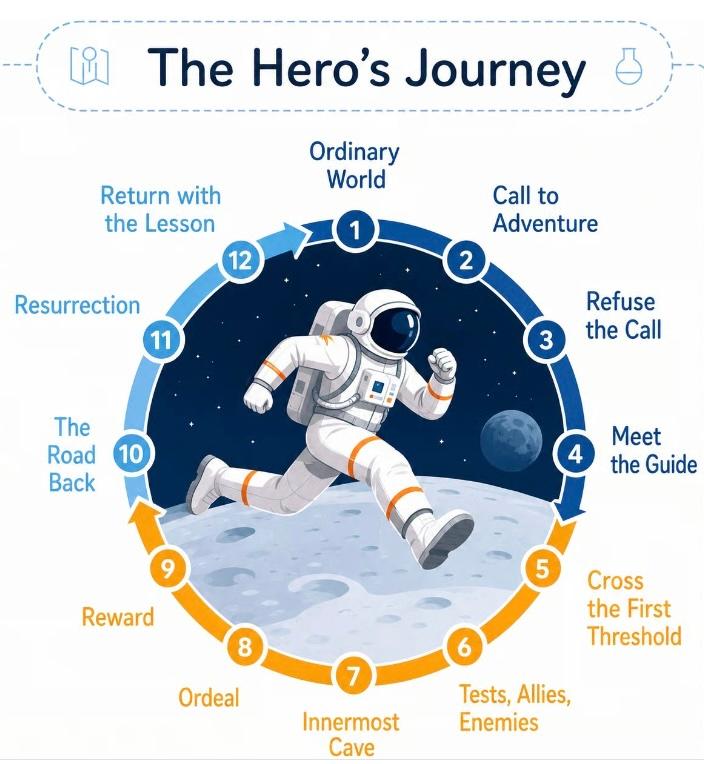
In 1949, Joseph Campbell wrote The Hero with a Thousand Faces (New World Library) in which he presented the Hero’s Journey, also known as a monomyth. It begins with the hero receiving a call to adventure, then confronting trials and tribulations, and finishing with the resolution/return.
They then share their newfound wisdom to make the world a better place (see above image).
That’s just one of the interesting factoids you’ll learn from the new online publication Star Compass, created by Todd Mosher, Ph.D., a University of Colorado Scholar in Residence.
It’s a weekly newsletter helping space students and aerospace professionals navigate their careers. Mosher is a fourth-generation Coloradan who spent 36 years in aerospace: human spaceflight, satellites, and launch vehicles. He was a 2024 Presidential Leadership Scholar and is a Fellow of The Explorers Club.
Subscriptions are free:
starcompass.beehiiv.com/subscribe
| | |
Tenzing
Coming in October to select theaters and Apple TV: Tenzing, a biographical drama film directed by Australian Jennifer Peedom (Sherpa) and written by Australian Luke Davies. It stars Genden Phuntsok as Tenzing Norgay, Tom Hiddleston as Sir Edmund Hillary, and Willem Dafoe as expedition leader John Hunt. Tenzing Norgay’s eldest son Norbu Tenzing is co-executive producer.
The story follows Norgay's rise from a little-known Himalayan climber to one of the most recognized figures in mountaineering history. It also explores the encouragement he received from his wife, Dawa, and the partnership that helped Norgay and Hillary reach the summit.
According to promotional material for the film, “After six previous attempts, Tenzing risked everything for one final venture. He had to navigate treacherous politics and perilous weather as he embarked on the most significant climb of his life. Through it all, he did so with humor, warmth, and generosity towards his fellow climbers, but also deep reverence and respect for the sacred Mother Goddess of his Mountain, Chomolungma.”
Learn more:
https://www.youtube.com/watch?v=DWaEVBeQpgQ
| | IBM's abandonded facility in Somers, New York | | |
Urban Explorers Get Their Kicks from Trespassing. We'll Pass.
They’re a group as passionate about exploration as any member of the Royal Geographical Society or Explorers Club. Except these so-called urban explorers (urbex) get their kicks from prowling abandoned malls, hospitals, power plants, amusement parks, factories and any other disused structure they can breach. Usually illegally.
According to the Wall Street Journal story by Scott Calvert (July 7, 2026), police in Livingston, New Jersey, recently warned people to stay out of the closed Livingston Mall property. Jacksonville Beach, Florida, police issued a similar caution in April about the shuttered Adventure Landing amusement park: “We are aware of a Tik-Tok challenge to explore the property.”
In Somers, New York, social-media images of the old IBM campus – a sprawling, pyramid-studded 1980s complex designed by the late I.M. Pei’s firm – show dystopian scenes: busted windows, tossed rooms and graffitied walls.
“It actually gives me hope when I hear that kids are out there getting into trouble,” says Bradley Garrett, a cultural geographer and author of the book Explore Everything: Place-Hacking the City (Verso, 2013) about his own urbex adventures. He sees urban exploration as “a gateway drug in a good way, sometimes, into intellectual curiosity about history and culture.”
Some explorers who have posted about the IBM site say they follow an observe-and-preserve ethos and reject vandalism. They say they’re driven by curiosity, the thrill of roaming forbidden spaces and a zeal to document discoveries – and that they’re careful and know their limits, Calvert reports.
Read the story (might be paywalled):
https://www.wsj.com/us-news/ibm-campus-explorers-somers-new-york-e3dfe489
Watch a 23-min. video tour of the abandoned 1 million s.f. IBM facility Somers for an idea of how these urban explorers roll. Or go floss the dog. Honestly, it’s not very exciting and not our jam.
https://youtu.be/YNjeT6qo2q8?si=og4n5qFDxJ5k3dMu
A rather icky pastime in New York City is to explore its sewers – certainly not for the faint of heart, according to this Associated Press story by Philip Marcelo (June 4, 2026):
https://apnews.com/article/nyc-sewer-explorers-manhole-investigation-6704bfa6158a914db051fb6f4ac35218
EXPEDITION INK
| | |
Rules to Live By
If ever there was a famous outdoor industry hyphenate, it’s Jimmy Chin, American professional mountain athlete, photographer, skier, film director, and author.
Rules to Live By is his new book on pre-order from Celadon Books – a collection of ten conversations with ten extraordinary people who have helped Chin think more deeply about that question, “what really matters?”
It features Lynsey Addario, Annette Bening, Simone Biles, Yvon Chouinard, Alex Honnold, Bill King, Yo-Yo Ma, Ridley Scott, Kelly Slater, and Kristine Tompkins.
Chin posts, “Putting this book together reminded me how fortunate I've been to learn from the people around me – mentors, friends, collaborators, and those willing to ask the hard questions.”
Pre-orders available through:
jimmychin.com
WEB WATCH
| | |
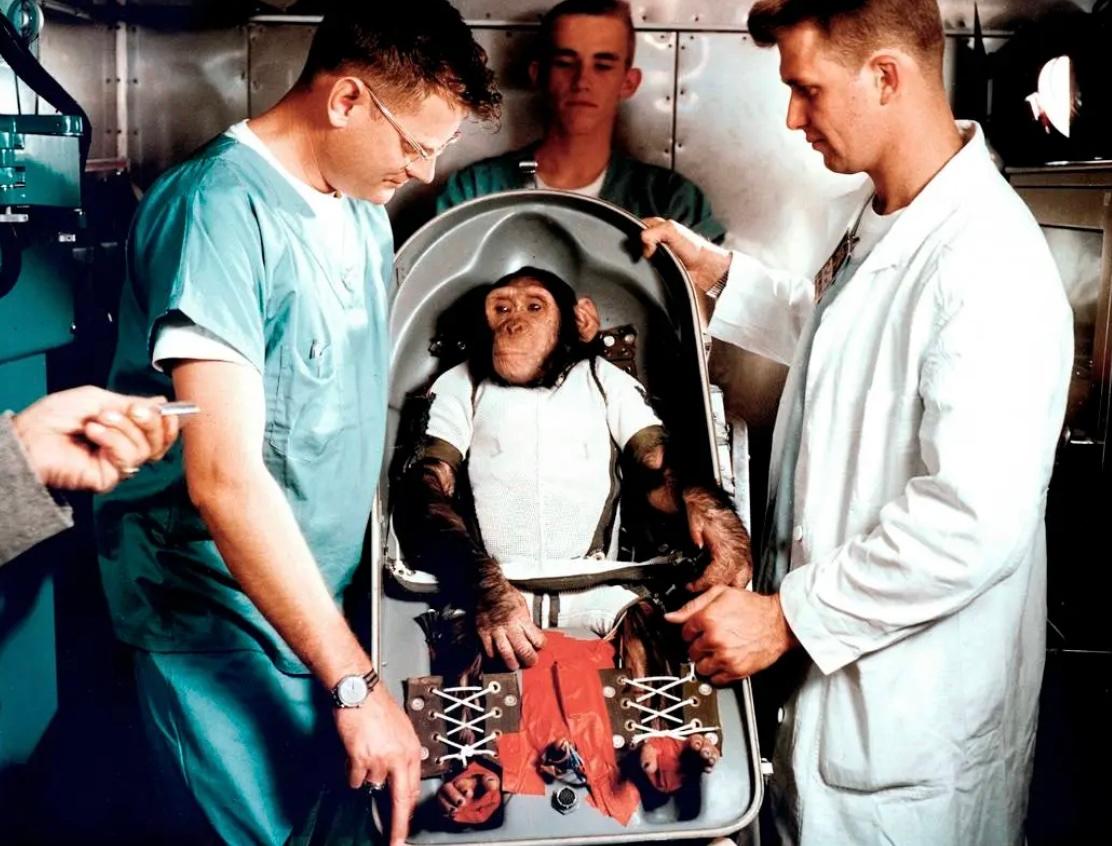
America’s most famous space chimp was Ham. On January 31, 1961, Ham made history by becoming the first hominid in space, flying a 16-minute suborbital mission aboard a Mercury-Redstone rocket.
Ham died in 1983, at the age of 25 (a relatively young age for a chimpanzee). Part of him was buried with honors; his skeleton was kept for its scientific value.
Primatologist Jane Goodall later noted that onboard footage of Ham during the flight showed expressions of absolute terror, changing how many look back on the early use of animals in the Space Race. (Photo: NASA)
| | |
Space Chimps: The Forgotten Astronauts
In the early decades of space exploration, a group of chimpanzees were bred for the U.S. program to understand the impact of leaving Earth’s atmosphere. But what happened when their tour of duty was over? George Knapp and Ron Futrell explore the story of medical research and animal welfare violations on a show called Mystery Wire, an investigative news program, web series, and podcast based in Las Vegas.
Chimps were captured in Africa, bred, and used for the space program. Afterwards, according to Knapp, “they were just dumped,” which included medical testing – dissection, infected with AIDS, even cooked to death. Animal welfare groups contend that if the government can afford to spend $100 million breeding the chimps, they can afford a fraction of that to bring them home.
Watch it here:
https://www.youtube.com/watch?v=OQUq99Bukck
| | |
“Kids Like Anything That Can Kill You”
One of our guilty pleasures is to combine outdoor exercise – especially walking – with listening to inspiring podcasts. One of our favorite series is Geographies of Hope with Dr. Karen S. Barton, a geographer, professor of geography, and storyteller based at the University of Northern Colorado in Greeley.
In the June 3, 2026, episode she asks what kind of person spends their life driving toward storms instead of away from them? She speaks to George Kourounis – National Geographic explorer, storm chaser, and host of Angry Planet – about chasing tornadoes across the American plains, rappelling into volcanoes, and documenting some of the most extreme environments on Earth.
Kourounis says kids ask great questions when he goes on speaking engagements. “They throw plenty of curve balls. They’re particularly fascinated with anything that can kill you.”
Listen to it here:
https://open.spotify.com/episode/7LsrFjVsneg2HAdX2YeEX0
BUZZ WORDS
| | |
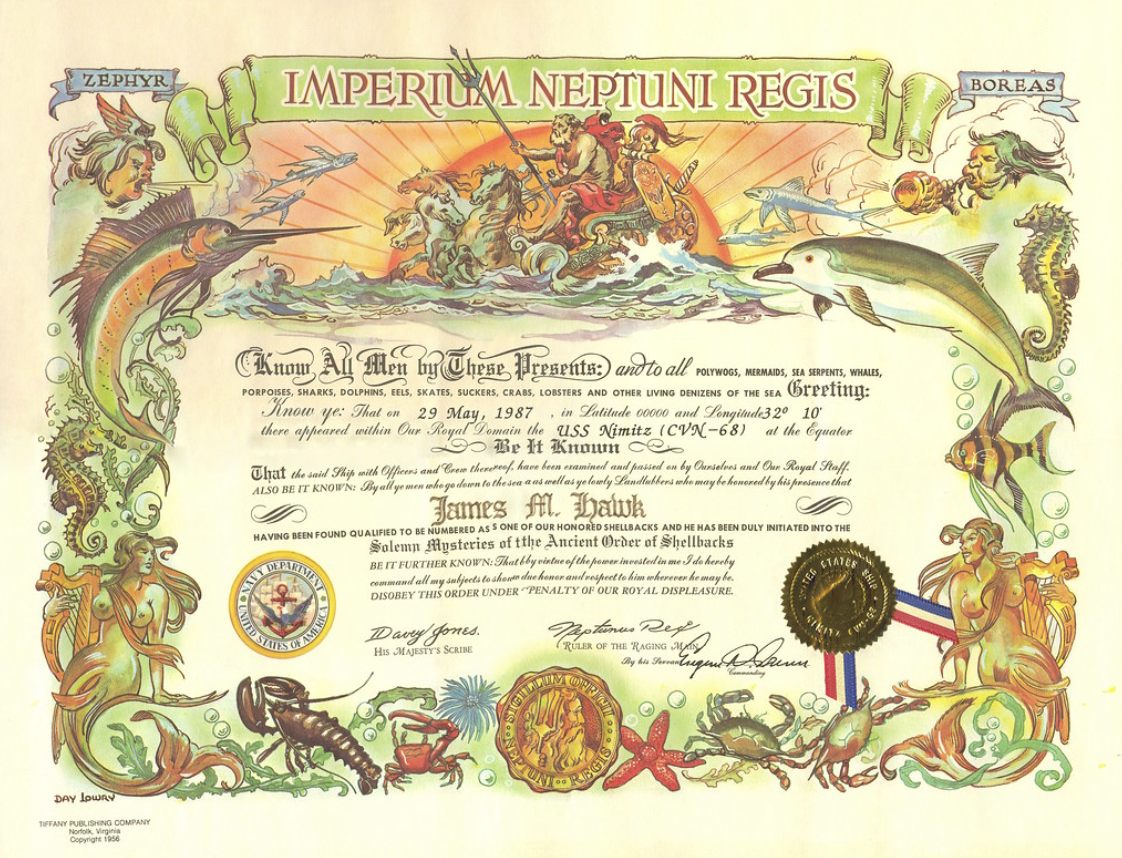
This shellback certificate from Tiffany Publishing is the
traditional R-rated version.
| | |
Blue Noses, Red Noses and Shellbacks
This could very well be the motherlode of buzz words. Seems there’s a strong Navy tradition of honoring sailors for just about any voyage to the four corners of the world. Some of these achievements have been celebrated by the U. S. Navy for decades, and in some instances, centuries.
Since 1953, Tiffany Publishing based in Norfolk, Virginia, has been issuing ceremonial certificates to honor:
Shellbacks – crossing the Equator
Blue Noses – crossing the Arctic Circle
Red Noses – crossing the Antarctic Circle
Golden Dragons – crossing the International Dateline
Order of the Rock – transiting through the Strait of Gibraltar
Order of the Ditch – transiting the Panama Canal
For some reason, the shellback certificate comes in two versions: the traditional shows scantily clad mermaids (above).
The revised version features mermaids in more modest attire, as if ever there was a sweating, swearing, swilling sailor alive who would be offended.
For more information:
https://www.tiffanypublishing.com/certificates/
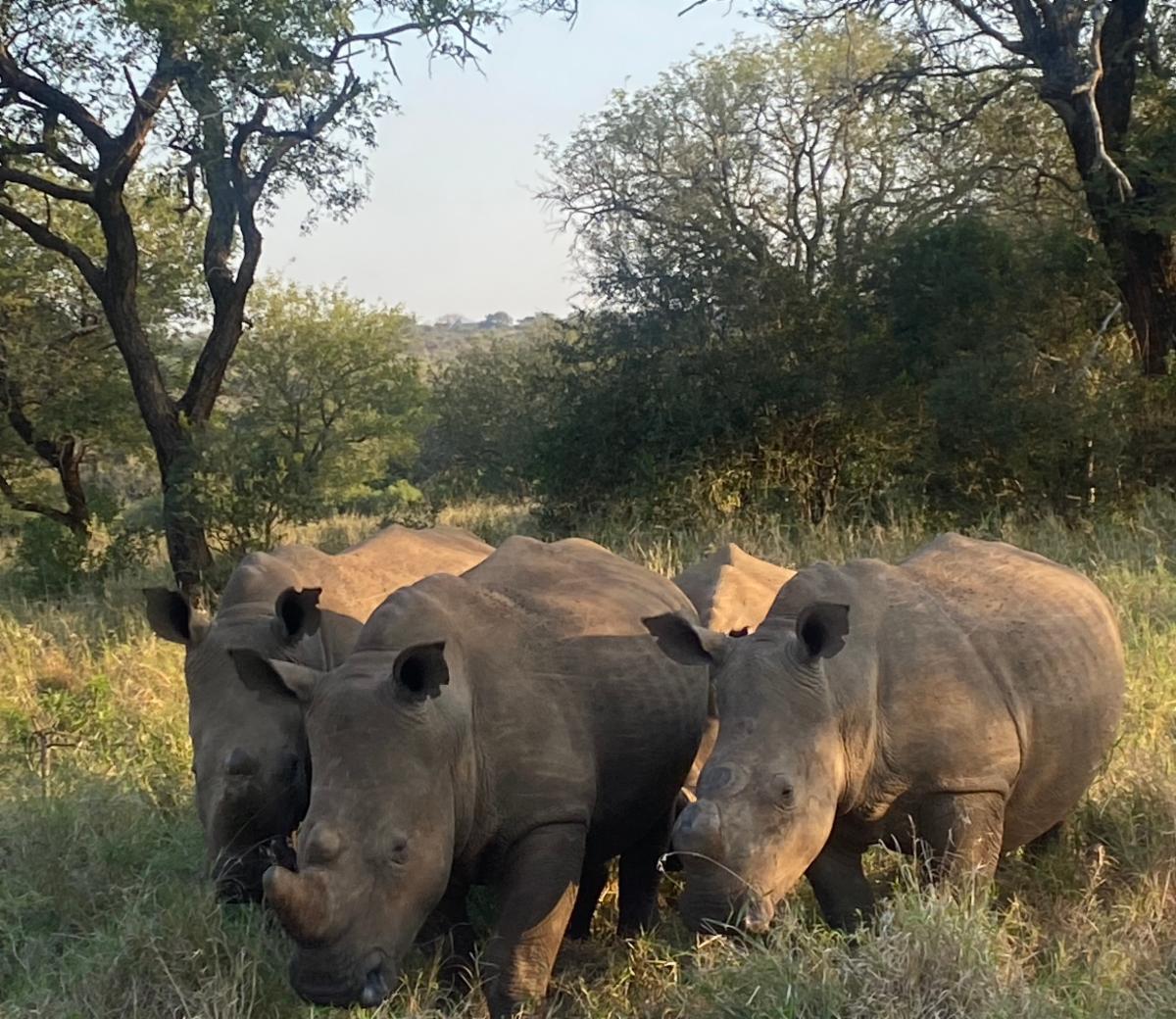
| | A crash of rhinos in South Africa. The animal in the foreground is ready for a manicure to protect it from poachers. (See related story.) | | |
Bird’s the Word – A Dazzle of Zebras, A Crash of Rhinos
When traveling to South Africa on a conservation mission it helps to understand the local lingo. No, not vuvuzela (plastic horn), robot (traffic light), lekker (awesome), or braai (barbecue). We’re talking about dazzles, crashes, and parliaments.
Most of the famous collective nouns we use today – like a murder of crows, a pride of lions, an unkindness of ravens, or a gaggle of geese – were first compiled and popularized in The Book of Saint Albans, published in England in 1486.
That year, Dame Juliana Berners (c. 1460–1500), a noble-born lady turned nun, published her thoughts on hunting. Her book was about the hobbies of gentlemen of the time: hunting, hawking (now more commonly called falconry), and heraldry. After Berners’ hunting chapter there is an appendix with 165 collective nouns for animals commonly encountered while hunting.
While some terms were practical, many were created as clever linguistic jokes based on the animal's perceived personality or folklore. For example, ravens were thought to be cruel, hence an unkindness of ravens.
“Within the birds alone, there are some good ones. Some of my favorites are a murder of crows, a committee of vultures, a conspiracy of ravens (what are they conspiring about?),” writes Emma Roth for the Audubon Community Nature Center in Jamestown, New York (Aug. 6, 2024).
“When bats come together, they form a cauldron. Squirrels form a scurry, and a group of bears is, strangely enough, called a sloth, while sloths themselves do not seem to have a widely agreed-upon collective noun.”
Some other favorites:
A parliament of owls
A prickle of porcupines
A business of ferrets
A flamboyance of flamingos
A pride of lions
An ambush of tigers
See more collective nouns here:
https://www.britannica.com/science/Animal-Group-Names
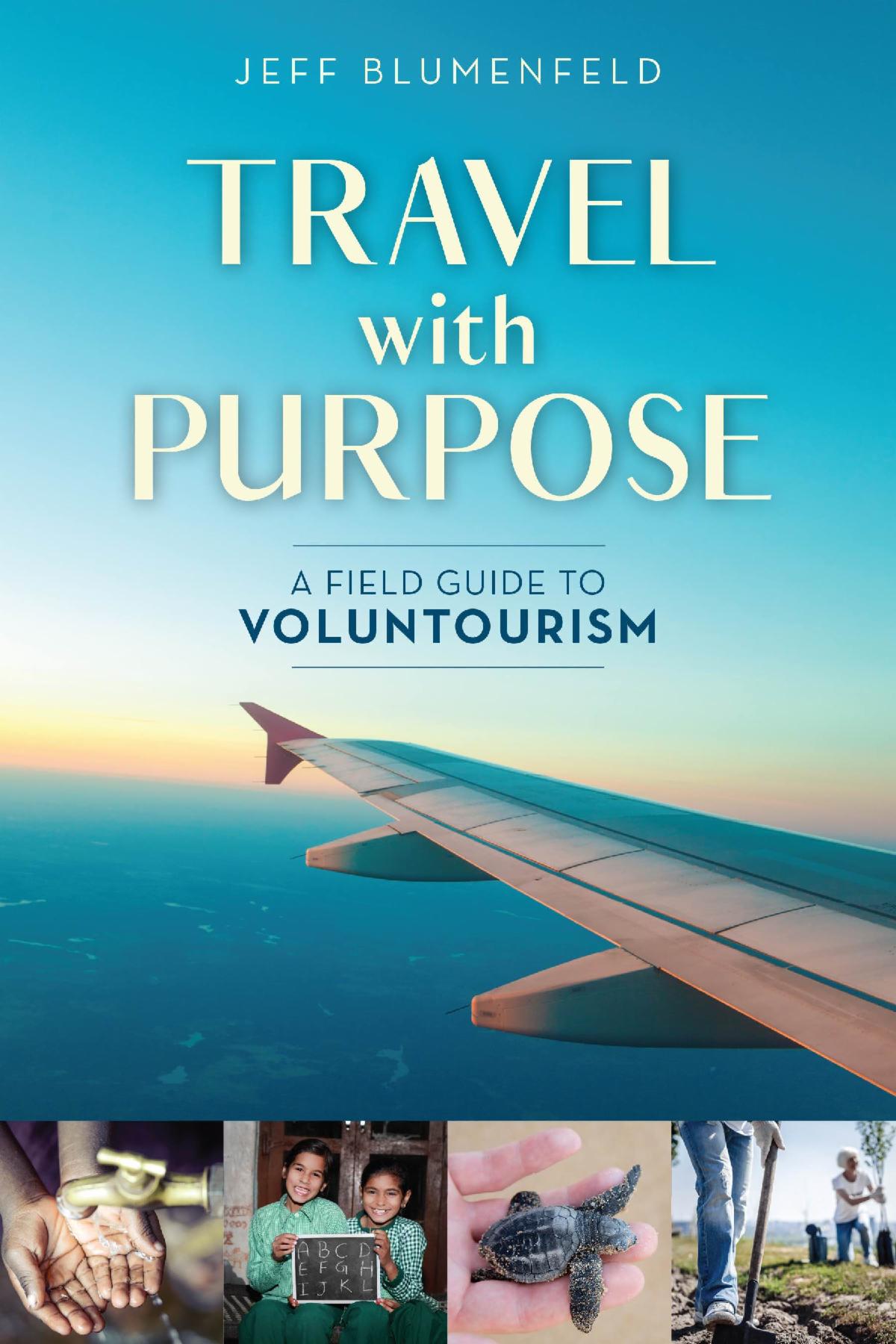
| | Travel With Purpose, A Field Guide to Voluntourism (Rowman & Littlefield) by Jeff Blumenfeld – People are traveling in record numbers and many include voluntourists. Be ready to lend a hand wherever you go. How to travel and make a difference while you see the world? Read excerpts and “Look Inside” at: tinyurl.com/voluntourismbook | | |
Get Sponsored! – Need money for your next project? Read about proven techniques that will help you find both cash and in-kind sponsors. If the trip is bigger than you, and is designed to help others, well, that’s half the game right there. Read Jeff Blumenfeld’s Get Sponsored: A Funding Guide for Explorers, Adventurers and Would Be World Travelers.(Skyhorse Publishing).
Purchase it here:
http://www.amazon.com/Get-Sponsored-Explorers-Adventurers-Travelers-ebook/dp/B00H12FLH2
Advertise in Expedition News – For more information: blumassoc@aol.com
EXPEDITION NEWS is published by Blumenfeld and Associates, LLC, 290 Laramie Blvd., Boulder, CO 80304 USA. Tel. 203 326 1200, editor@expeditionnews.com. Editor/publisher: Jeff Blumenfeld. Research editor: Lee Kovel. ©2026 Blumenfeld and Associates, Inc. All rights reserved. ISSN: 1526-8977. Subscriptions: US$36/yr. available by e-mail only. Credit card payments accepted through www.paypal.com. Read EXPEDITION NEWS at www.expeditionnews.com.
Research past issues of Expedition News dating back to May 1995 courtesy of the Utah State University Outdoor Recreation Archive. Access is free at: https://tinyurl.com/ENArchivesUSU
Add your comments to the new Expedition News Facebook page: https://tinyurl.com/ExpedNewsFB
| | | | |